Esther M. Zimmer Lederberg
Other Dishonesties
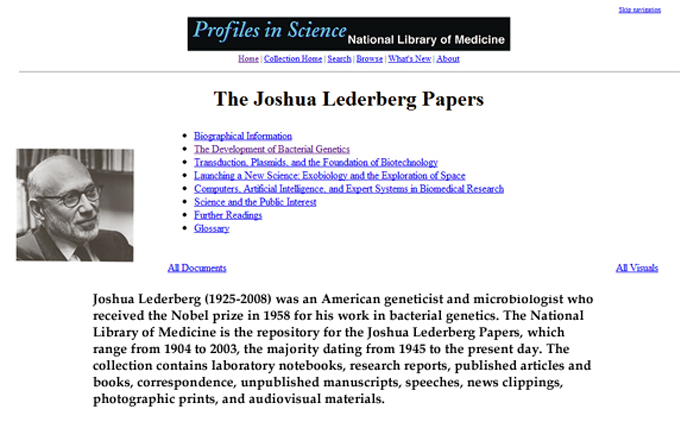
Home page for Joshua Lederberg's NLM website, which starts by falsifying
the historical record. There is a Nobel prize for "Physiology or Medicine",
not bacterial genetics; also, the Nobel prize for Physiology or Medicine
was awarded to three people, not one person: Joshua Lederberg, Ed. Tatum
and George Beadle.
J. Lederberg: The Disinterested Archivist
An "archive" is an extensive record or collection of documents,
photographs and other objects, held in a central collection usually
with the purpose of preservation: for possible access or possibly to
prevent access.
.
In order to facilitate the gathering and preservation of all relevant
material (not only the material that casts a favorable light upon the
subject), the archivist should be someone who is unbiased, or even
disinterested. It is not the archivist's duty to judge the subject of
the archive. The duty of the archivist is to gather information, then
preserve the material, and hopefully make it accessible. The archivist
should use the best tools available at the time, only limited by
possible costs.
.
It is for this reason that autobiographical archives, begun while the
subject is still alive and even gathered with the subject’s own
assistance, are not necessarily the best archives. Such archives are
inevitably biased. As such, the items not selected, given away or
deemphasized, or purposely buried may be deemed more interesting
than the items that are actually made available.
.
The National Library of Medicine, in accepting enthusiastic
assistance and participation from Joshua Lederberg in the internment
of his own archive, has succeeded in creating not so much an
unbiased archive, as a well-orchestrated public relations website.
The NLM "Profiles in Science: The Joshua Lederberg Papers" amply
provides evidence for this that any user can prove to themselves.
As a consequence, much of historic value that could have been
derived from Joshua Lederberg’s scientific papers, has (perhaps
inadvertently) been destroyed.
1. Issues of Stewardship: Joshua Lederberg
Scope of material
In a 1991 oral history interview at Rockefeller University
(see the NLM "Profiles in Science" site for Joshua Lederberg,
document ID bbbdgm#),
Joshua Lederberg claimed to be selflessly
concerned about the loss of documentation (resumes, notes,
correspondence, etc.); not only documentation that directly
pertained to him, but also to many other researchers. While
Joshua claimed to be concerned with maintaining the historical
record, the potential for conscious as well as unconscious or
unknowing censorship is all too obvious. (Joshua Lederberg is
not a disinterested party to his own archive.)
.
At the time of their divorce in 1966, Joshua Lederberg
took possession of correspondence between Esther M. Lederberg
and other researchers (sometimes including himself). He also
took possession of items clearly belonging only to Esther M.
Lederberg, such as her Masters and Doctoral theses. Instead of
making copies of the stolen correspondence available to Esther
Lederberg, and returning her personal property, Joshua Lederberg
"donated unconditionally" those papers and correspondence to Stanford
University, thereby burying relevant historical documents that were not
his own property. On September 16, 1970, Esther M. Lederberg requested
that photographs, theses, and copies or originals of correspondence
from "Cavalli, Jacob, Wollman, Hayes, Stocker, etc." be returned
to her. Almost immediately (September 17, 1970), Joshua Lederberg refused
to return the stolen property, which he stated was now "the property
of the Department (i.e. not me)". It is rare that one can obtain
documentary evidence of deliberate misappropriation of property;
click here to see the evidence of
this misappropriation.
.
Interestingly enough, many of the documents that Joshua Lederberg
claimed to have donated unconditionally to Stanford University, now
appear at his "Profiles in Science" NLM website, without permission
from Stanford University. Thus, Joshua Lederberg misappropriated the
same documentation twice: once from Esther M. Lederberg and other
researchers, and a second time from Stanford University. The
misappropriated documentation not only falsely inflates Joshua
Lederberg's own archive, but it supports his exaggerated, inappropriate
or utterly false claims about his own work, as well as on the research
of others.
.
#
This specific piece of correspondence may be found on Joshua
Lederberg's NLM website, identified with the ID bbbdgm.
See http://profiles.NLM.NIH.gov/BB/.
Virtual censorship
The inflated scope of material that was in Joshua Lederberg’s
possession at the time of its donation to the National Library of
Medicine, adversely affects the historical record, as it makes it
extremely difficult to piece together complete information about
the collaborations of other researchers.
Simply stated, the omitted documents destroys the full context of
the remaining material of the other researchers. (This is called
"bias".) Thus, it serves to obscure or even (effectively) censor
the historical record. While it is true that records can be
searched for at the NLM website for Joshua Lederberg, if found
they must then be retrieved. It is much worse if the omitted
documents must be searched for (if available) at many other
archives at other locations throughout the world.
.
Another way of censoring is to make documents available, but in
such poor condition that it is difficult to read the documents:
specifically, by not using available methods to improve the
legibility of images of the documents.
.
One must bear in mind that there is no way to know what
documents have been placed in the physical NLM archive
for Joshua Lederberg (whether in rightful possession or
otherwise), but not been made public. For example, if a
series of documents by several researchers pointed out
something that might be unflattering to Joshua Lederberg
(such that a particular claim he made was outright false
or questionable), these might be hidden (censored).
2. Issues of Stewardship: National Library of Medicine
Poor or careless duplication
Much of the correspondence donated by Joshua Lederberg to
the National Library of Science was several decades old.
Often correspondence gets torn and may be patched together
with transparent tape. In such cases, the tape discolors
over time and begins to obscure the writing under the tape.
One must take special care to restore or at least manually
interpret or read the partially-obscured writing under the
tape. Mechanically "scanning" the document without care for
items that have holes or are taped together, will subject
the document to the artificial reflectivity of the scanner.
At times this can "black out" the entire strip of tape and
all the writing underneath it. This effectively redacts the
writing, thus partially destroying the value of the
correspondence.
.
In other cases, the original documents were written on thin
or translucent paper stock, such as "onionskin" paper. In
such cases, if the correspondent(s) wrote or typed on both
sides of the paper, the writing on the other side is visible,
and can easily be confused with or obscure the writing on
the side that is currently presented. No effort was made to
enhance readability of such documents by reducing or
eliminating the writing on the opposite side of the sheet.
.
Another form of poor stewardship takes place where documents
age and discolor, and the writing fades. A conscientious
steward makes attempts to enhance the fading writing on
the image (not the original document): darkening the writing,
increasing contrast, removing speckles ("noise" or dirt), etc.,
making writing that has become obscure, as legible as possible.
Perhaps not all the writing will be lost.
.
Unfortunately, the NLM in many cases has not made this effort.
The result is that many of the duplicated documents that are
made available to the public, are effectively defaced;
essentially rendered illegible (censored).
Removal of color
Colors may be very significant. For example, a document typed
using a black ribbon produces black print, but often the
correspondent may add further commentary by hand, using a
different color ink. When more than one color ink is
discernible, the possibility that one person wrote commentary
multiple times, or even that multiple people wrote commentary,
is addressible. Since the documents in the Joshua Lederberg
archive were scanned in black and white, information was lost
that might have been visible in color. Thus, the historical
record is further compromised (censored).
Faulty indexing
The National Library of Medicine has coded the documents in
Joshua Lederberg’s archive for easier retrieval via search.
Unfortunately, many documents which were either from, or
addressed to, Joshua and Esther Lederberg jointly, are
not coded appropriately. Some documents that were addressed
to both individuals are coded as having been addressed only
to Joshua. This omission can be construed as a clerical mistake,
and as such not malicious in intention, but it nevertheless
obscures the historical record and makes rectifying the
historical record difficult. (People must search the NLM
archive for Joshua Lederberg very assiduously to locate these
mistakes!) This is also a form of censorship.
.
In addition, there are several documents pertaining to
"Esther Zimmer" which are not retrieved when searching for
"Esther M. Lederberg", even though Esther M. Lederberg was
Esther M. Zimmer before she and Joshua were married.
Similarly, a search of documents for "Esther M. Lederberg"
does not retrieve documents written by or otherwise pertaining
to, Esther Zimmer.
Click to see that the searches are not reliable.
.
Destruction of context
Several researchers may engage in a conversation,
sending correspondence back and forth between each
other, stating their research results and posing
questions to each other. The results of such
conversation suggests further research. Thus, the
historical record is not a single document, but a
set of documents. If documents are removed from
this set, the context of the research engaged in,
is destroyed; we no longer know what the researchers
were thinking and what they said to each other. Thus,
a partial record may serve to censor the historical
record of discovery, possibly to make a particular
person appear more important.
Possible copyright infringement
Copyright applies to the author of a document or the originator of an
object (such as a photograph). Thus, if "A" writes to "B", "A" holds the
copyright to the letter, but does not own it (it has been given to B);
"B" owns the document itself, but does not own the copyright (the right
of reproduction). Should another person "C" (other than "A" or "B") wish to
copy "A"'s letter to "B", then "C" must obtain copyright permissions
from "A" and legally obtain the letter itself, from "B". If "C" were
to steal the letter in qustion from "B", then even with "A"'s copyright
permission "C" would be guilty of theft. This justifies
the use of the phrase "intellectual piracy".
.
The distinctions made above are not vacuous. For example,
this website displays a 1954 letter from Masahiko Oda to Esther M.
Lederberg (only). The NLM states that they could not find the
copyright holder (Dr. Masahiko Oda), yet displays a copy of
this letter "courtesy of Joshua Lederberg". How did Joshua
Lederberg get his copy of this letter? Did Esther M. Lederberg
give Joshua Lederberg permission to copy her letter? In fact,
Esther Lederberg asked for her property to be returned, and
Joshua Lederberg refused. Thus, the NLM is in collusion with
Joshua Lederberg regarding the theft of this document from
Esther M. Lederberg. More: without Dr. Oda's permission to
reproduce the document (or the institution for which Dr.
Oda worked, which might inherit those rights after his
death), the NLM was knowingly in violation of U.S. copyright law.
Thus, the NLM is in collusion of theft and in violation of
U.S. copyright law.
.
The NLM site for Joshua Lederberg claims to have obtained
permission from nearly all the appropriate copyright holders
of the documents it displays. However, they do not display
the actual documents whereby this permission was granted.
(Perhaps some of the permissions were granted purely orally,
or perhaps they were imagined?) A selection of some of the
suspicious permissions is available on this website.
Click to see that the copyrights and permissions are faked.
In all cases where permission is stated
to have been obtained from Esther M. Lederberg, this claim is
categorically false.
The evidence is provided by the NLM itself! Click here to see it.
The falsity of this claim, pervasive on the NLM website, calls
all claims of appropriate permissions from any copyright
holders into question.
.
It behooves the NLM to substantiate their claims of having
obtained proper permission to display the documents on its
websites for Joshua Lederberg and others. At this point in
time (4/17/2011), all such permissions are in question. In
addition, even with copyright permissions, ownership rights
to documents are a separate matter. This is significant
considering the written statement by Joshua Lederberg that
he misappropriated (stole) Esther Lederberg's property
(correspondence).
Collusion in theft
Joshua Lederberg's documented theft of the correspondence,
photographs, and property of Esther M. Lederberg, as well
as that of L. L. Cavalli-Sforza, François Jacob, Elie Wollman,
William Hayes, Bruce A. D. Stocker and others, and the
subsequent appearance of the correspondence on the NLM's
"Profiles In Science" website for Joshua Lederberg, amounts
to collusion on the part of the NLM with Joshua Lederberg's
theft. This is compounded by the display of utterly fake
permissions and copyrights, in opposition to U.S. Copyright law.
3. Are other NLM "Profiles In Science" sites equally compromised?
By gathering correspondence that perhaps did not belong to
him, Joshua Lederberg potentially compromised the historical
record regarding the research and relationships of literally
hundreds of scientists. For a list of scientists whose papers
were discovered in the NLM website for Joshua Lederberg, and
where permission to display those papers and correspondence
is dubious.
.
The issues of stewardship raised above should be strongly
considered when accessing the other Profiles In Science
websites created by the NLM, especially as they have a
bearing on both Esther M. Lederberg's archive and Joshua
Lederberg's Profiles in Science archive. To date
(12/17/2010), these include:
- Francis Crick
- Arthur Kornberg
- Salvador E. Luria
- Barbara McClintock
- Linus Pauling
- Sol Spiegelman
4. Recommendations concerning the NLM "Profiles in Science" Website
For all the above reasons, it is highly recommended that the
NLM "Profiles in Science" Web site be limited in use only as
a secondary source of information.